Homeschooling does not have to mean purchasing every textbook, worksheet, subscription, or activity guide. From complete K–12 curriculum to virtual museum collections, printable planners, audiobooks, hands-on projects, and advanced high-school coursework, there are excellent free resources for nearly every subject and learning style.
A quick note before you begin: “Free” can mean different things across websites. Some resources are fully free, while others provide free samples, printable units, educator accounts, limited free access, or state-funded enrollment opportunities. Always check current access, enrollment, age, testing, and printing requirements before building a full plan around a resource.
The goal is not to use everything in this list. Pick a few quality resources that fit your learner, your goals, and the amount of prep time you realistically have.
Free Complete Homeschool Curriculum
1. Easy Peasy All-in-One Homeschool
A free, online, day-by-day curriculum for preschool through high school. It includes lessons across core subjects and frequently links to free books, videos, and printable activities. It is especially helpful for parents who want a ready-made sequence rather than assembling every lesson themselves.
Think of this as a large directory of free curriculum rather than one curriculum provider. Search by subject, grade level, and type of resource to find complete programs and supplements for all ages. It is a good starting point when you want to compare multiple free curriculum options in one place.
Core Knowledge offers downloadable, content-rich curriculum materials from preschool through grade 8. Families can filter resources by grade and subject, then download individual materials or complete units. This is a strong choice for secular families looking for organized history, science, literacy, and knowledge-building instruction.
This publisher offers free printable curriculum and resources, including selected K–8 materials in language arts, math, science, and enrichment. Check the site carefully for which complete courses and individual lessons are currently available at no charge. Personal note: This is not my favorite option, and I do not personally recommend it—but to each their own. It is a freebie.
A free Charlotte Mason–inspired curriculum with rich book lists, weekly schedules, and guidance for K–12 families. It is especially appealing for literature-rich, history-centered homeschoolers who enjoy narration, living books, nature study, and short lessons.
A free online curriculum with daily lessons and assignments across core subjects. It can be useful for families who prefer a more traditional grade-level structure.
A free curriculum option with lesson plans and materials, particularly useful for elementary years. It includes a structured selection of subjects and printable resources.
8. Sherlock Homeschooling’s All-in-One Room Schoolhouse
A free, complete-curriculum option designed to be straightforward for parents to implement while covering rigorous academic expectations.
9. CK-12
CK-12 provides free digital FlexBooks, practice activities, simulations, and adaptive learning resources. It is especially valuable for middle- and high-school math and science, but it also includes materials in other subjects.
A robust, secular source for full ELA units for K–12 and math curriculum from grade 3 through Algebra 2. Its materials are particularly useful for content-rich texts, substantial writing, strong discussion questions, and coherent yearlong planning. Use it as a complete subject curriculum or as a high-quality framework to adapt for an advanced learner.
A free, secular, day-by-day online curriculum for grades 6–8. It includes daily lessons and is helpful for families looking for a more structured middle-school plan without purchasing a boxed curriculum.
12. Brightly Beaming Resources
A fully free early-childhood and elementary curriculum option, with materials from preschool through approximately age 11. It is useful for themed lessons, early-literacy activities, and a simple framework for younger children.
A free, literature- and textbook-based homeschool resource with grade-level plans, book lists, daily schedules, and links to public-domain texts and materials for K–12. The site has an older format, but it can be a treasure trove for families willing to curate and adapt resources.
14. K12 Learning Hub
K12 Learning Hub offers thousands of free lessons, videos, and activities. It is not a ready-to-open-and-go full homeschool program, but it is an excellent multi-subject library for filling gaps, building unit studies, or supporting a child who wants to go deeper into a topic.
Free Language Arts and Reading Resources
Read online or download thousands of public-domain books at no cost. Build a literature-rich homeschool around classics, poetry, biographies, historical primary sources, and vintage children’s books.
16. Libby
Many libraries provide free access to e-books, audiobooks, magazines, and sometimes educational databases through Libby. All you usually need is a library card.
17. Hoopla
Depending on your local library system, Hoopla may provide free access to audiobooks, e-books, comics, music, movies, and educational content.
18. Storyline Online
Children’s books read aloud by actors and paired with simple activity guides. This is especially useful for preschool and early-elementary read-aloud time.
19. ReadWorks
Free reading passages, vocabulary work, comprehension questions, and article sets. It can be a lifesaver when you need targeted practice for a particular reading skill or grade band.
20. CommonLit
A free digital library of reading passages, poems, short stories, and nonfiction texts with discussion questions and assessments. Best suited to upper elementary through high school.
21. K12 Reader
Offers free reading-comprehension passages, grammar pages, spelling materials, and writing activities organized by skill and grade level.
22. ReadTheory
A free online reading-comprehension practice platform that adapts to student performance. It is helpful for independent practice and informal skill monitoring.
23. Starfall
An early-learning resource with phonics activities, beginning readers, songs, and foundational math practice. It is especially helpful for preschool through early elementary.
24. Teach Your Monster to Read
A playful, phonics-based game for early readers that lets children create a monster and progress through letter-sound, word-building, and beginning-reading activities. It is free to play on computers through the website; app pricing and availability may vary by device.
25. Scott Foresman Grammar and Writing Handbooks
Free PDF grammar references and practice materials are available online for grades 1–6. They can support a straightforward, traditional grammar routine.
26. NaNoWriMo Young Writers Program
Look for free writing prompts, novel-planning pages, character worksheets, and classroom-style writing resources to encourage young authors.
27. Purdue OWL
A helpful free reference for older students learning grammar, citations, essay writing, research skills, and academic formatting.
Free Math Resources
Use it for concept lessons, independent practice, and mastery tracking from early math through calculus and statistics.
Free digital textbooks and adaptive practice make CK-12 a practical option for middle-school and high-school math.
30. Zearn Math
Zearn offers free digital math lessons and interactive practice aligned with grade-level concepts. It can be a useful option for elementary and middle-school learners who benefit from visual models, guided instruction, and independent online practice.
31. XtraMath
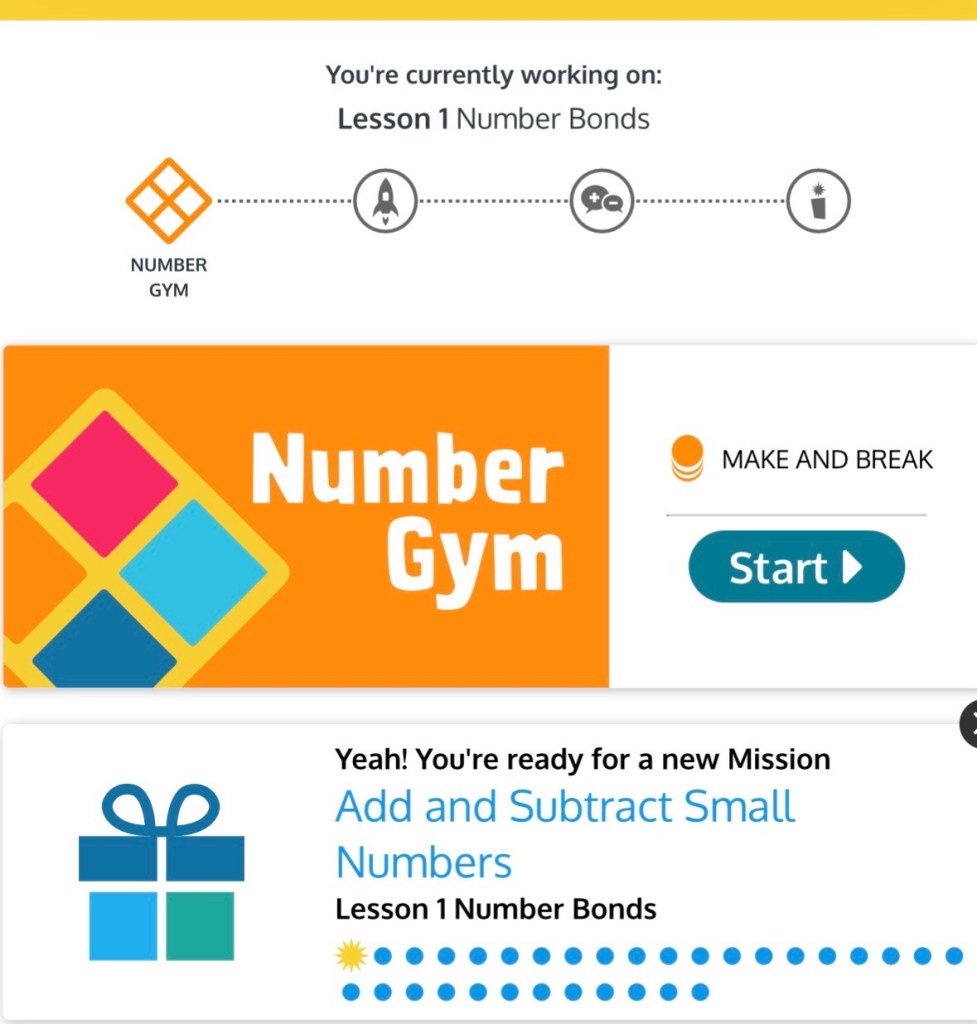
A simple resource for strengthening addition, subtraction, multiplication, and division fact fluency. Parents can also use its fact-progression ideas and reports to guide offline flashcard practice.
A game-based math practice option with free access. Review the free-tier limits before relying on it as a core program, but it can motivate learners who enjoy fantasy-style games.
33. Math Is Fun
Free explanations, examples, games, manipulatives, and reference pages for a broad range of math topics.
34. NRICH
A rich collection of low-floor, high-ceiling math problems from the University of Cambridge. This is a wonderful option for gifted learners who need more reasoning, problem-solving, and mathematical discussion than repetitive practice.
35. YouCubed
Free math tasks, mindset resources, and open-ended activities that encourage conceptual understanding and flexible problem-solving.
36. Illustrative Mathematics Tasks
Search its free tasks for discussion-rich problems that help children explain their mathematical thinking.
Free Science Resources
37. Mystery Science
Mystery Science periodically offers free mini-lessons and activities. These short, engaging lessons are ideal for a low-prep science afternoon.
NASA provides free lesson plans, activities, videos, engineering challenges, printable materials, and space-science resources for a range of grade levels.
Explore free materials on weather, oceans, climate, marine life, and environmental science.
40. National Geographic Education
A rich source of articles, maps, videos, photography, hands-on activities, and background information for nature study, geography, conservation, and world cultures.
Access millions of digital resources from Smithsonian collections, including artifacts, images, primary sources, videos, and curated lessons. It is particularly strong for inquiry-based science and history projects.
42. Science Buddies
Free science-fair project ideas, experiment instructions, career profiles, and topic guides for elementary through high school.
43. PhET Interactive Simulations
Free, high-quality interactive simulations in physics, chemistry, math, earth science, and biology. They are especially useful when an experiment would otherwise be too expensive, dangerous, or abstract.
44. The Cornell Lab of Ornithology
Free birding resources, bird-identification tools, live cams, sound recordings, and citizen-science opportunities. Pair these with a backyard nature journal.
Find junior ranger materials, virtual tours, historical resources, park-specific lesson plans, and nature-study inspiration.
Free History, Geography, and Civics Resources
Free videos, lesson plans, primary sources, interactive activities, and educational resources across history, science, arts, and civics.
An extraordinary source for historical photographs, newspapers, maps, letters, recordings, and primary-source analysis tools.
Explore original documents, photographs, lesson plans, and educator resources to bring American history and civics to life.
49. World History Encyclopedia
Free articles, images, timelines, and maps for ancient through modern history. Use it as a jumping-off point, then verify and deepen learning with books and primary sources.
Offers geography quizzes along with printable blank maps, worksheets, and flashcards for offline map practice.
51. Google Earth
Take virtual field trips, explore geography in 3D, trace journeys, compare landscapes, and investigate places connected to literature or history.
52. iCivics
Free civics games, lesson plans, and activities focused on government, constitutional principles, media literacy, and civic participation.
53. Ben’s Guide to the U.S. Government
A kid-friendly government resource from the Government Publishing Office, organized by reading level.
54. The Met’s Heilbrunn Timeline of Art History
A free way to connect world history with art, artifacts, geography, and culture.
Free Arts, Music, Technology, and Enrichment
Explore museums, famous artworks, cultural sites, historical collections, and virtual exhibitions from around the world.
56. The Kennedy Center Education Resources
Find arts activities, performance clips, lesson ideas, and creative prompts.
57. Hoffman Academy
Free piano lessons, printables, sheet music, and practice support for beginning musicians.
58. JustinGuitar
Free beginner guitar lessons, chord instruction, and practice guidance. It can work well for teens or as a parent-led music elective.
59. Chrome Music Lab
A playful, accessible way to explore rhythm, melody, sound waves, song creation, and basic music theory.
Eligible educators may be able to access free design tools for student presentations, posters, book reports, timelines, infographics, and homeschool portfolios. Review eligibility requirements before applying.
61. Instructables
Free maker projects spanning crafts, engineering, woodworking, electronics, cooking, and practical skills. Always supervise projects and adapt for age and safety.
62. KidzType
A free, kid-friendly online typing program with structured keyboarding lessons, practice exercises, and more than 30 browser-based typing games. It introduces key placement progressively—from the home row through numbers and symbols—and children can begin without creating an account or downloading anything.
Free Printables and Homeschool Planning Tools
Offers a large selection of free homeschool printables, including organization pages, record-keeping forms, preschool activities, and resources for older students.
Download free homeschooling resources, e-books, printable activities, and guides for families.
65. Teachers Pay Teachers Freebies
Search by grade, subject, standard, and keyword for free worksheets, unit studies, games, notebooking pages, and classroom-style activities. Read reviews and preview files, since quality varies by creator.
66. Education.com Free Worksheets
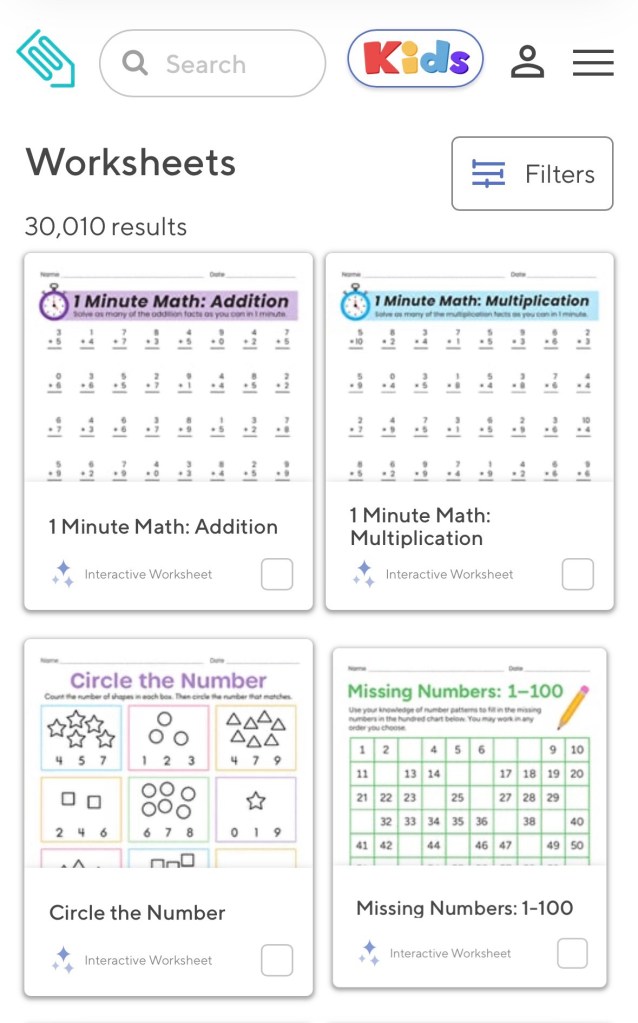
Offers a rotating selection of printable worksheets and activities. The free tier is limited, but it can be helpful when you need a quick, skill-specific page.
Check for free trials, sample lessons, unit studies, and seasonal homeschool offers. And definitely make sure to use them to create your free homeschool ID if you do not currently have one.
A useful source for free printable packs, preschool resources, unit-study materials, and organizational helps.
Known for free planners, forms, checklists, household-management pages, and homeschool record-keeping tools.
Look for free notebooking pages that encourage students to narrate, draw, research, and document learning in a more open-ended format than a standard worksheet.
71. Your Public Library’s Homeschool Collection
Many libraries offer free curriculum kits, museum passes, maker programs, databases, book clubs, STEM events, and librarian-curated learning lists. Never underestimate the library—it may be your most valuable free homeschool resource. Search your library website for “homeschool,” “museum passes,” “library of things,” “learning kits,” and “digital resources.”
72. Georgia Virtual Learning Digital Curriculum
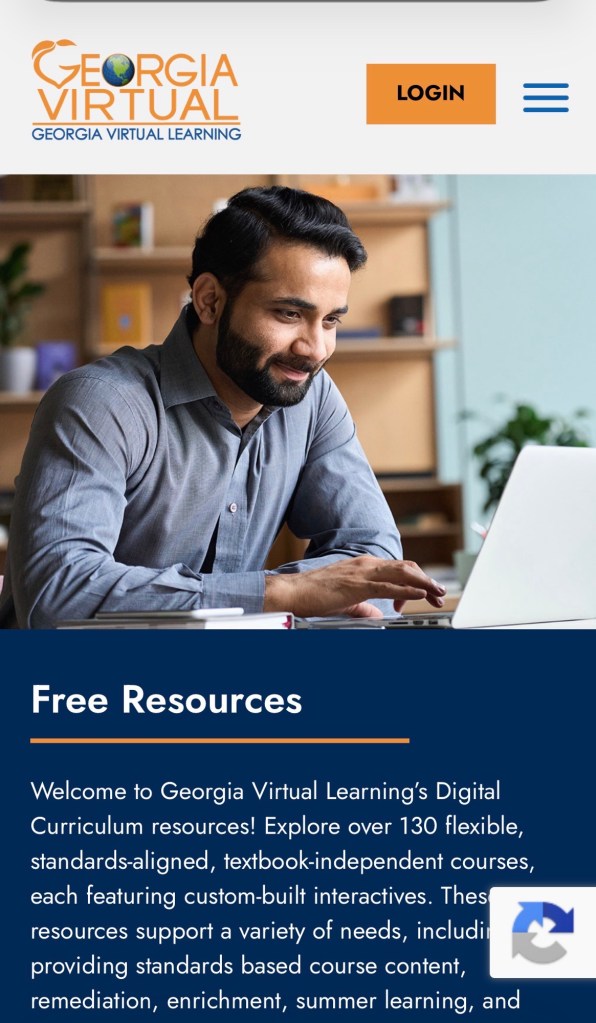
Georgia Virtual Learning provides free, standards-aligned digital curriculum, including more than 130 flexible, textbook-independent courses with custom-built interactives. The open curriculum includes full courses for grades 6–12 and supplemental elementary core-content resources. It can be used by families anywhere as a source of digital lessons and adaptable materials.
73. Georgia Virtual School Courses for Homeschoolers
Georgia homeschool students may be able to enroll in teacher-led Georgia Virtual School courses, including core subjects, electives, career and technical education, world languages, and AP classes. State-funded seats for homeschool and private-school students may be available in fall and spring on a first-come, first-served basis. Once those seats are full, tuition and fees may apply.
Parent tip: Georgia Virtual Learning’s free digital curriculum can be useful to any family, including families outside Georgia. The teacher-led Georgia Virtual School enrollment option is the portion with Georgia-specific eligibility and availability rules.
High School, AP, CLEP, and Exam Prep
74. Modern States
Modern States offers free, self-paced online courses taught by college professors that cover the material tested on CLEP exams. Subjects include college composition, literature, U.S. history, psychology, sociology, biology, chemistry, math, economics, business, and world languages. Required digital textbooks and assessment materials are included.
Students age 13 and older can create a free account. After completing course quizzes and the final exam with a 75% average, students may request a voucher that covers the CLEP exam fee. Testing centers can still charge a separate administration fee, so check your local testing center before registering.
This is an excellent option for motivated high-school students who want to explore college-level coursework or potentially earn college credit. Before investing time in a course, families should confirm that the student’s prospective college—or dual-enrollment plan—accepts the specific CLEP exam and awards credit in a way that fits their degree goals.
75. Khan Academy AP Courses and Review
Khan Academy is the strongest fully free nationwide option for homeschoolers seeking AP-level instruction. It offers videos, articles, practice exercises, and exam-style review in subjects such as AP Calculus AB/BC, Statistics, U.S. History, World History, Art History, Physics, Chemistry, Biology, Macroeconomics, and Microeconomics.
Khan Academy’s AP content is excellent preparation, but it is not an accredited AP course and does not by itself provide AP course credit. Students can self-study and take the official AP exam, but families should add labs, essays, free-response feedback, substantial reading, and a well-documented syllabus where appropriate.
76. Official College Board AP Resources
For every AP subject, College Board provides a free Course and Exam Description, often called a CED. These documents outline required units, skills, topics, and exam weighting. They are the best starting place for building a homeschool AP syllabus that actually aligns with the test.
College Board also releases past free-response questions, scoring guidelines, sample student responses, and reader reports. These are particularly valuable for AP English, history, government, economics, science, and math because they show what high-scoring work looks like.
77. AP Classroom
AP Classroom provides official AP Daily videos, progress checks, question banks, and extra practice. Access usually requires a join code from an AP teacher or approved course provider, so it is not always available to independent homeschoolers. Ask the school where your student plans to test whether access can be provided.
78. Georgia Virtual School AP Courses
Georgia Virtual School offers more than 25 teacher-led AP courses. Georgia homeschool students may access a limited allotment of state-funded seats in fall and spring on a first-come, first-served basis; once the seats are gone, tuition may apply, along with an AP course fee.
Georgia homeschool students must arrange AP testing with a local public school. Contact schools early because AP exam ordering deadlines arrive months before spring testing.
79. Khan Academy Digital SAT Prep
Khan Academy’s Official Digital SAT Prep offers diagnostic practice, targeted lessons, quizzes, and full-length practice support. It is a practical starting point for high-school students preparing for the SAT.
Use College Board’s free Bluebook app for official full-length digital practice exams for the SAT, PSAT/NMSQT, PSAT 10, and AP exams that use the digital testing application. Pair official Bluebook practice with Khan Academy’s targeted lessons.
ACT offers free online practice questions and test-prep materials. It is a wise addition for students who may apply to colleges that accept either ACT or SAT scores, since student strengths can vary between the two exams.
A free independent-study resource with CLEP and DSST study guides, exam overviews, and subject-specific preparation suggestions. It can complement Modern States by helping students identify what they still need to study before scheduling an exam.
83. Official CLEP Study Resources
College Board provides official CLEP exam descriptions and a limited set of free practice questions for each exam. Use these near the end of a study plan to confirm content coverage and become familiar with the wording and style of official questions.
84. DSST Exam Prep
DSST exams offer another potential route to college credit in areas that may not have a comparable CLEP exam, such as Environmental Science, Principles of Public Speaking, Ethics in America, Criminal Justice, and technical or business topics. Free-CLEP-Prep can help students identify study topics, while paid providers such as Peterson’s offer official-style DSST practice tests.
Always check whether a prospective college accepts DSST exams—and the specific exam your student intends to take—before building a course around it.
A free practice site with questions and online tests for the ACT, SAT, PSAT, and AP exams. It is best used as supplemental review rather than the only instructional source; official College Board and ACT resources should remain the benchmark for exam format and score expectations.
Understanding AP, CLEP, DSST, SAT, and ACT
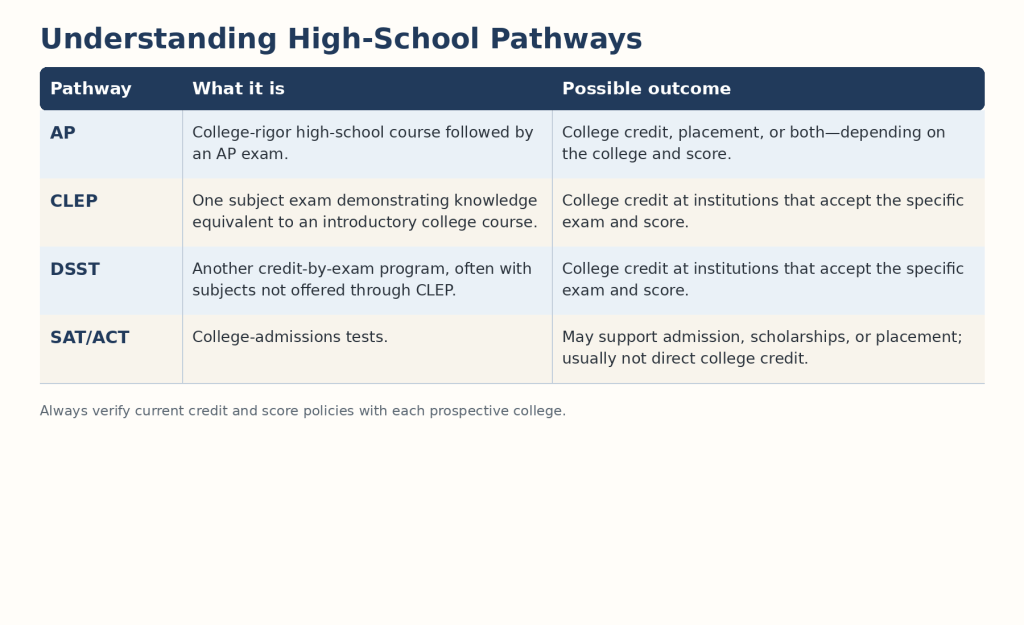
For every pathway, check the specific college’s current policy before your student spends months preparing. A passing score does not automatically translate into credit everywhere, and schools differ in the exams, scores, course equivalents, and maximum number of credits they accept.
How to Use Homeschool Freebies Without Overwhelm
A giant list of resources can be just as overwhelming as an empty lesson plan. The goal is not to use everything; it is to choose a few high-quality tools that fit your children and your family’s rhythm.
1. Choose one primary resource for each core subject.
2. Add one enrichment source tied to each child’s interests or strengths.
3. Keep a “save for later” list instead of downloading every printable immediately.
4. Use your library, museums, parks, local events, and community classes as part of your curriculum.
5. Reassess every six to eight weeks: What is working? What is unnecessary? What does your learner need next?
For example, a middle-school gifted learner might use CK-12 for science, Khan Academy for a math gap or acceleration, Core Knowledge for history units, Project Gutenberg for classic literature, and NRICH for challenging math problems. That creates a flexible, rigorous, mostly free plan without trying to recreate a traditional school day at home.
The best homeschool freebie is the one you will actually use. Start with your goals, your child’s learning profile, and the amount of prep time you realistically have—then let these resources fill specific needs rather than clutter your homeschool shelves or browser tabs.

